header image

header image

Saturday, October 22, 2016

Octavius Catto and Charles Remond Douglass


In 1866, the U.S. Civil War was barely over and the ink was still drying on the newly ratified Thirteenth Amendment to the Constitution.  Slavery had officially been abolished, but, throughout the country, Americans of African descent were still harshly being denied access to basic human and civil rights.  A new generation of black leaders was emerging to follow in the footsteps of abolitionists such as Frederick Douglass and Harriet Tubman.  Among them were Octavius Catto in Philadelphia, and Charles Remond Douglass, youngest son of Frederick Douglass.  It's unclear whether Catto and Douglass intended to be baseball pioneers, but they both sought to recruit and organize young black men.  In the second half of the 19th century, the best way to do that was through baseball.

Sunday, July 24, 2016

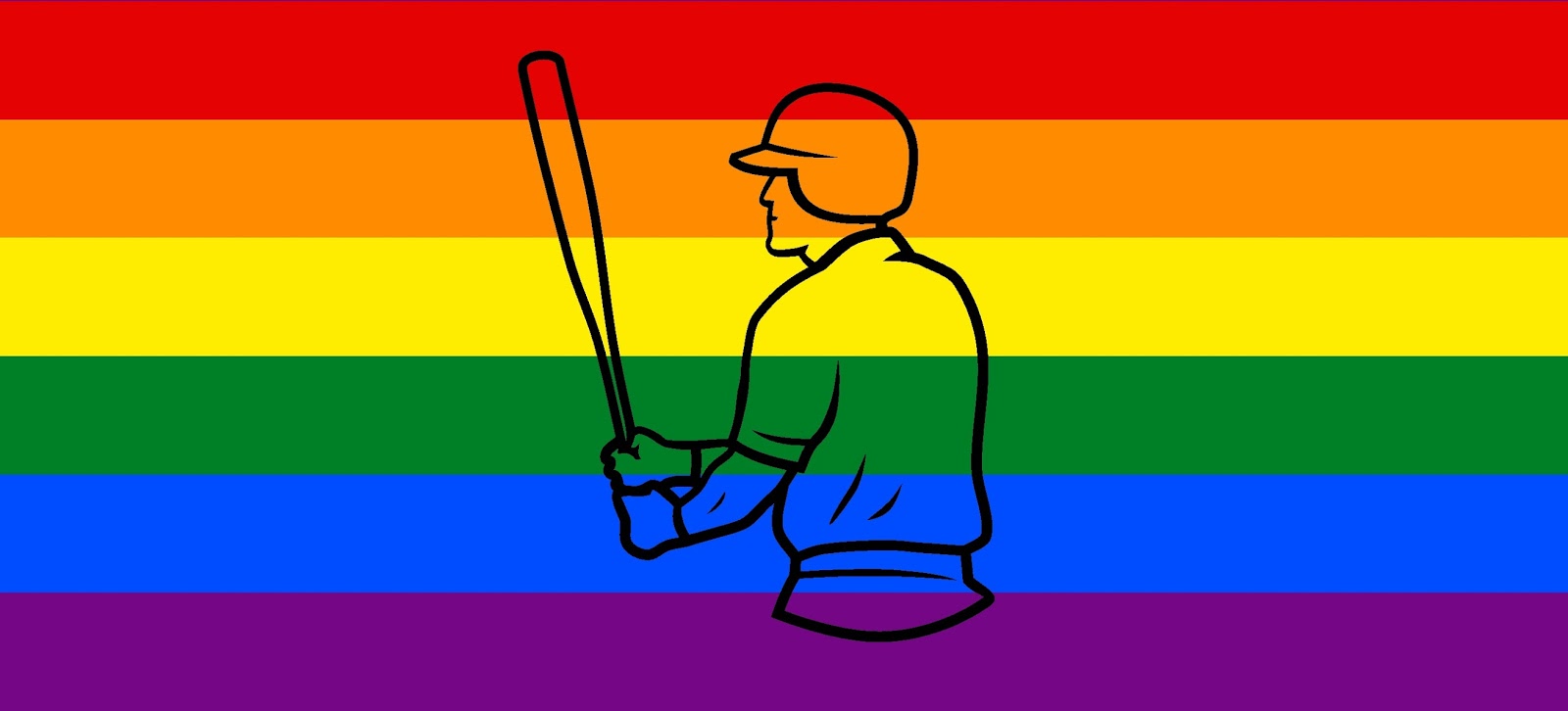
LGBT & the MLB: 1976 - 2016


Glenn Burke was an outfielder for the Dodgers and A's in the late 1970s.  Although he never publicly came out during his career, most of his teammates were aware of his sexual orientation.  Well-liked by the players, but seen as a public image problem by Dodger management, he was traded to Oakland for arguably a less talented player (the motive of the trade is still debated).  With the A's, Burke was subjected to derogatory treatment and hateful speech, pushing him out of the league for good.  Years later, he confided "I finally got to the point where it was more important to be myself than a baseball player."  35 years after Burke's retirement, in 2014, pitching prospect Tyler Dunnington played one season in the minors, where he was not comfortable coming out to his teammates.  He endured hearing homophobic language in the locker room, including the condoning of violence towards LGBT individuals.  At the end of the year he walked away from the game he loved, later saying "I felt I had to choose between being an out gay man or playing baseball."

Tuesday, May 31, 2016

Kenichi Zenimura and Japanese-American Internment Leagues

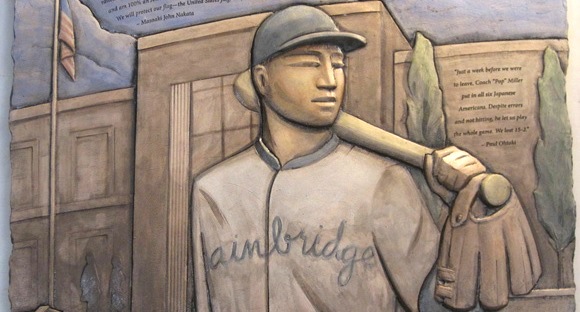
A scene from the Bainbridge Island Japanese American Exclusion Memorial

In 1942, more than 110,000 Japanese-Americans were abruptly removed from their homes and forced to re-locate on ten internment camps scattered through-out the western United States.  Among the interned was Kenichi Zenimura; a star player, coach and organizer in the California Japanese League.  Upon arriving at the Gila River War Relocation Center, he immediately began transforming a patch of harsh Arizona desert into a beautiful baseball oasis.  Considering the lack of  resources available to him, this required a rare brand of ingenuity.  According to the Nisei Baseball Research Project, he extended a pipe from one of the laundry rooms to grow the outfield grass.  Children were recruited to meticulously remove the pebbles from the infield dirt and re-purpose them as ground cover in the dugouts and stands.  Along with  excess wood from the lumber yard, every other post was removed from the perimeter fence and used to construct a backstop and bleachers.  Flour was acquired from the dining hall to chalk the foul lines and high-growing shrubs were planted along the path of the outfield "wall".  Other internment camps built baseball fields of their own, but "Zenimura Stadium" was the crown jewel (a literal diamond in the rough).


Saturday, April 30, 2016

Jackie Robinson's 1945 Tour of Venezuela


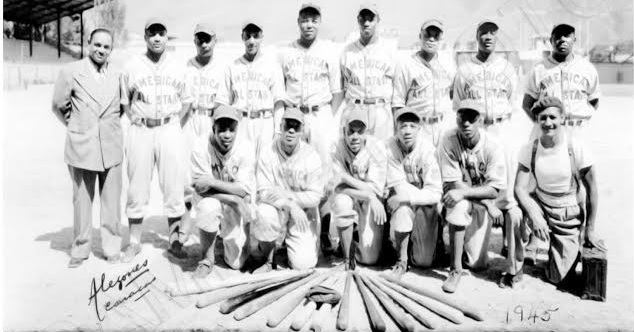
On October 23, 1945, Jackie Robinson signed a historic contract to play with the Montreal Royals, the top-tier minor league franchise of the Brooklyn Dodgers.  The signing and the legendary career that resulted are well-documented.  His tour of Venezuela that immediately followed the signing, as part of a Negro Leagues all-star squad, is barely documented at all.  Information about the trip varies from source-to-source.  Depending upon where you look, it was either two months or ten weeks.  Another source specifies 24 games without mentioning a time frame.  Some researchers claim that Branch Rickey himself assigned Robinson to the traveling team, while most others fail to identify the impetus for him making the trip.  Whatever the reason, and for ever how long, the American All-Stars' (referred to by the local press as Las Estrellas Negras - The Black Stars) visit to Caracas and Maracaibo was an important step in Robinson's development as a player.

Monday, March 28, 2016

The History of Baseball's History (Part II): Beyond Doubleday


In Part I of this post, I review the nationalistic debate that led to the formation of the Mills Commission.  Assembled by Albert Spalding, who insisted that baseball was an American invention, their task was to determine the origin of the sport once and for all.  Spalding hand-picked the members himself, choosing only those who agreed with him.  To head the commission, he appointed his good friend, former National League President A.G. Mills (years earlier, Mills had delivered a patriotic speech on baseball's early development, while the crowd banged their tables and chanted "No rounders!  No rounders!  No rounders!").  It took the commission three long years to release its findings.  They finally concluded the game was created in 1839 by late Civil War general Abner Doubleday.  A small town in upstate New York, by the name of Cooperstown, was picked for the setting.  The commission's sole piece of evidence was the recollection of a man who was only five years old at the time of the events in his testimony.  Doubleday, who kept a regular diary and enjoyed penning letters, made no such claims - at least not in his writings (in fact, he barely mentioned the sport at all).  Despite having known Doubleday while he was alive, neither Spalding nor Mills  added any first-hand knowledge in support of the commission's report.

Wednesday, February 10, 2016

The History of Baseball's History (Part I): Chadwick-Spalding


Everyone knows that the game of baseball was invented by Abner Doubleday.  Or was it Alexander Cartwright?  Or could it have been a lesser-known New Yorker by the name of William R. Wheaton?  Whoever invented it, one thing we do know for certain is that sport was adapted from the similar game of Rounders... or Town Ball... or the children's game One Old Cat. If you ever want to make your head spin, spend a day looking into the origins of America's favorite bat-and-ball game.  What you'll find is that baseball history has a history.  

Monday, November 30, 2015

Miners, Mormons and 120 Years of Baseball in South Africa


If you run a basic internet search for the history of baseball in South Africa, you'll find a few articles that start with the game's appearance in 1895 and then quickly jump ahead to the 2000 Olympics.  To discover what happened during the century in between requires some digging.  You must dig past the greater popularity of "the big three" (soccer, cricket and rugby); past the absence of head-line grabbing superstars in the likeness of Babe Ruth or Willie Mays; and down deep through the decades of segregation and discrimination that conceal a large part of the story.  If you dig deep enough, you'll eventually unearth a treasure chest full of the surprising and curious events that led to the unlikely rise of baseball far away from its native land.

Saturday, October 31, 2015

1908 World Series: The Curse Begins


The day is October 14, 1908.  The Chicago Cubs have just defeated the Tigers to repeat as World Series Champions.  The win caps a five-game match-up featuring a hall of fame infield of Tinkers, Evers and Chance, a 21-year old Ty Cobb, and great pitching from Cubs' hurlers Orval Overall and Mordecai "Three Finger" Brown.  Yet there is no joy in Chicago.  Cubs fans are angry and the players feel betrayed.  Sports writers are fed up with their working conditions and team owners will soon meet to debate, among other topics, whether to do away with the World Series all together.  Just one week earlier, the city was riding high with anticipation.  To find out what went wrong, let's rewind the clock.

Monday, August 31, 2015

The Unknown Journey of the Havana Sugar Kings


The Havana Sugar Kings was a Cuban-based team, founded in 1946 by Joe Cambria, an Italian-born scout in the U.S. professional baseball system, and sold in 1954 to Roberto "Bobby" Maduro, a Cuban of Jewish descent.  They won league championships in 1947, '48, and '57 as minor-league affiliates of the Senators and Reds, before growing tensions with Castro's government prompted the them to embark on a journey of Homeric proportions.  The year was 1960 and the team once known as The Cubans was heading to America.  It would take them a full decade to find a permanent home there.

Monday, July 27, 2015

The Opposite of Baseball Diplomacy


A few months ago, I posted two articles about America's baseball diplomacy with Japan and Cuba.  It made me wonder, if baseball could be used to build good will between nations, could it also be used for military gains?  In other words, could baseball literally be a game of war?

Thursday, July 2, 2015

Shoeless Joe: The Rest of the Story


Stop me if you've heard this one.  Shoeless Joe Jackson was a naive, uneducated mill worker who was taken advantage of by corrupt gamblers.  Along with seven of his teammates, he was banned from baseball for his alleged involvement in the 1919 World Series scandal - despite his excellent play during the series (.375 batting average with no errors) and favorable verdict from a grand jury.  Afterwards, a heartbroken Jackson quietly disappeared from the limelight.  Unable to walk away from the game he loved, he continued to play under an alias for small-town and semi-pro teams.  According to one well-known source, Jackson appeared post-humously on a magic field in the middle of an Iowa corn farm, where his ghost was at long last able to enjoy the sport free from the harsh accusations of team owners and league commissioners. There is a tragic romanticism induced by these stories, and if that's how you'd like to remember the legendary player then stop reading now.  If you'd like to hear the rest of the story, continue on...

Tuesday, June 2, 2015

The Ghost of Josh Gibson


Josh Gibson, one of the greatest hitters of all time, dreamed of breaking baseball's color barrier.  It may be that he nearly got his wish.  It's rumored that at least two teams, the Pirates and the Senators, pursued Gibson during his prime in the late 1930s and early 1940s.  Sadly, the powers that kept black players out of the Majors were very strong and neither team could get the deal done.  Some say the team owners caved to pressure from the Commissioner's Office.  Others speculate that the influential Negro Leagues boss Cum Posey had his hand in delaying integration, knowing that it would be the beginning of the end for his lucrative franchise.  Several popular white sports figures of the day, such as pitcher Walter Johnson and journalist Shirley Povich, opined for Gibson's inclusion in the MLB - along with other talented black players - but to no avail.  Years after Gibson's death, Larry Doby (the player who integrated the American League) said "One of the things that was disappointing and disheartening to a lot of the black players at the time was that Jackie [Robinson] was not the best player.  The best was Josh Gibson.  I think that's one of the reasons Josh died so early.  He was heartbroken."

Friday, May 15, 2015

The History of Baseball Diplomacy Part II: Cuba


Through the first half of the 20th Century, Major League Baseball enjoyed a healthy fellowship with the Cuban leagues.  Cuba hosted MLB spring training games, the U.S. hosted traveling Cuban teams, and for a few years the Cincinnati Reds incorporated the Havana Sugar Kings into their minor league system.   In 1947, the Brooklyn Dodgers held their Spring Training in Havana to make life a little easier for Jackie Robinson (who was about to break MLB's color barrier).  But the fellowship came to a grinding halt shortly after Fidel Castro came to power in 1959.  It would be 40 years before an American baseball team returned to the island nation.

Friday, April 24, 2015

The History of Baseball Diplomacy Part I: Japan


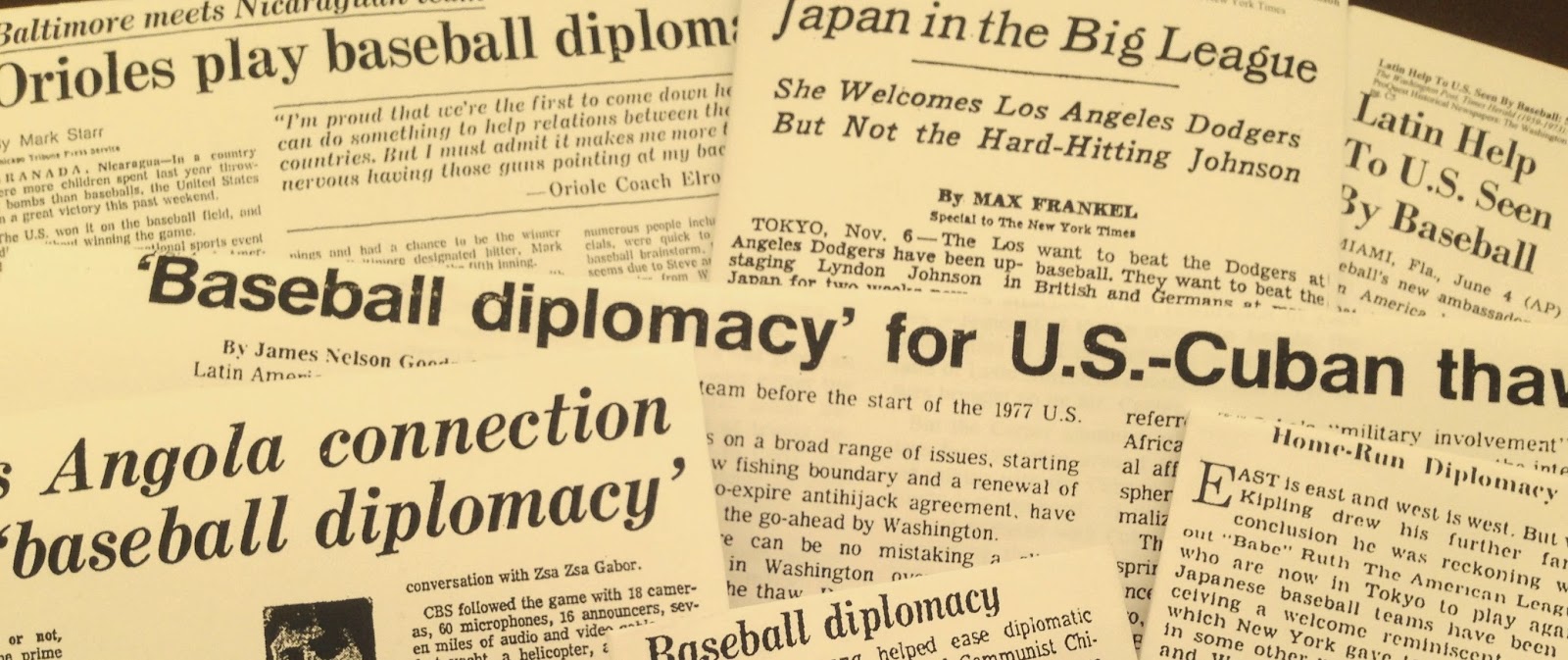
It has been called by many names - Baseball Diplomacy, Diamond Diplomacy, Home Run Diplomacy - but the concept is always the same.  By exchanging ball-players instead of politicians, and competing on athletic fields instead of battlefields, two countries can bypass complex government relations and generate a sense of good will among the people.  And it's not just baseball.  Basketball, soccer, ping pong and pretty much any sport you can think of has served this purpose at one point or another over the past several decades.

Sunday, March 1, 2015

Finding Baseball in the Philippines


Baseball has a long and interesting history in the Philippines, dating back to 1898 and its introduction by U.S. soldiers.  In the 1910s and 20s, the Philippines had regular exchanges with the United States and Japan.  Well known stars such as Tris Speaker, Red Faber, and John McGraw toured the islands, while Filipino players barnstormed through America.  In 1934, Lou Gehrig and Babe Ruth hit the first two home runs at the newly constructed Jose Rizal Memorial Stadium - a ballpark in Manila that still hosts games to this day.  The sport's popularity declined after World War II, but experienced a brief resurgence in the 1950s, culminating in 1954 with a first place finish at the Asian Baseball Championships.  Even today there are active little league systems and collegiate circuits, and the national team slowly comes closer to qualifying for the World Baseball Classic.  There's only one problem with baseball in the Philippines... nobody knows about it!  Not even people in the Philippines!

Tuesday, January 27, 2015

Babe Ruth and Leon Day


Ever since their playing days, baseball followers have been comparing Babe Ruth and Negro Leagues slugger Josh Gibson.  In some ways, it's a fair comparison.  Both men were the defining home run hitters in their respective leagues and generations.  I could go on for a long time about Josh Gibson's athletic accomplishments, as I intend to in a future article, but in my opinion a better comparison would be Babe Ruth and hall-of-fame pitcher Leon Day.  Ruth and Day both grew up in Baltimore.  They were both child prodigies and initially signed as teenagers by Baltimore teams.   Both were great pitchers who  also became known for their hitting prowess.  Both played professional ball for 22 years.  And the similarities don't stop there.  Ruth's last full season as a player was the same year as Day's first season in the Negro Leagues (1934).  At the beginning of that year, Ruth's New York team (the Yankees) offered him a position as the manager of the Newark Bears (he declined).  Two years later, Day's New York team (the Eagles) left New York and moved to Newark, where they shared a stadium with the Bears.  But my favorite similarity is how both men are honored and remembered in the Baltimore area.

Wednesday, December 31, 2014

The old Eastern Shore League in a Day


Despite producing four Hall of Famers and numerous other major league talents, very little is written about the Eastern Shore Baseball League (defunct since 1949).  A quick Google search gets you only a few relevant hits, interspersed among a plethora of links for present-day little league and high school teams.  Amazon.com boasts two books (one of which is in stock), while the Wikipedia page consists of a terse paragraph followed by a quick list of teams.  In other words, you can't find much on the Eastern Shore League through the internet or books.  If you want to learn about it, you need to go see it for yourself... or at least what remains.  Once you're in the area, you can pretty much do it all in one very full day.

Monday, November 3, 2014

Road-Tripping the 1903 World Series


A few days ago, Giants' ace Madison Bumgarner capped off a historically impressive World Series performance, bringing the Commissioner's Trophy to San Francisco for the third time in five years.  In doing so, he added his name to an elite list of legendary big-gamers in the fall classic.  The list goes all the way back to Denton True "Cy" Young, who pitched in the very first World Series 111 years ago.  Today, inspired by the Bumgarner's recent heroics, I'd like to take you on a virtual road trip to October of 1903, when the mighty Cy Young and his Boston Americans took on Honus Wagner and the rest of the Pittsburgh Pirates in the first championship series between the American and National leagues.

Thursday, October 9, 2014

Back To Beginnings


It was a bright September morning and I was driving up I-95 towards New York.  New York is a great baseball state:  two major league (and several minor league) teams, the sport's national Hall of Fame, and the final resting place for such legends as Babe Ruth, Lou Gehrig, Jackie Robinson, plus countless others.  Yes, I was heading TOWARDS New York... but that's not where I was going.  My destination for the weekend was a little closer to my starting point.  A state with no MLB teams; I was looking forward to a baseball-themed weekend in New Jersey.

Tuesday, September 2, 2014

Elbow to Elbow


I hadn't planned on writing this article. I prefer to focus on topics and personal anecdotes that don't receive a lot (if any) of press. Besides that, what the heck do I know about the ulnar collateral ligament? But with the need for Tommy John surgery reaching epidemic proportions, I've come to understand that these players don't need more experts... they need advocates.