header image

header image

Monday, March 28, 2016

The History of Baseball's History (Part II): Beyond Doubleday


In Part I of this post, I review the nationalistic debate that led to the formation of the Mills Commission.  Assembled by Albert Spalding, who insisted that baseball was an American invention, their task was to determine the origin of the sport once and for all.  Spalding hand-picked the members himself, choosing only those who agreed with him.  To head the commission, he appointed his good friend, former National League President A.G. Mills (years earlier, Mills had delivered a patriotic speech on baseball's early development, while the crowd banged their tables and chanted "No rounders!  No rounders!  No rounders!").  It took the commission three long years to release its findings.  They finally concluded the game was created in 1839 by late Civil War general Abner Doubleday.  A small town in upstate New York, by the name of Cooperstown, was picked for the setting.  The commission's sole piece of evidence was the recollection of a man who was only five years old at the time of the events in his testimony.  Doubleday, who kept a regular diary and enjoyed penning letters, made no such claims - at least not in his writings (in fact, he barely mentioned the sport at all).  Despite having known Doubleday while he was alive, neither Spalding nor Mills  added any first-hand knowledge in support of the commission's report.

Wednesday, February 10, 2016

The History of Baseball's History (Part I): Chadwick-Spalding


Everyone knows that the game of baseball was invented by Abner Doubleday.  Or was it Alexander Cartwright?  Or could it have been a lesser-known New Yorker by the name of William R. Wheaton?  Whoever invented it, one thing we do know for certain is that sport was adapted from the similar game of Rounders... or Town Ball... or the children's game One Old Cat. If you ever want to make your head spin, spend a day looking into the origins of America's favorite bat-and-ball game.  What you'll find is that baseball history has a history.  

Monday, November 30, 2015

Miners, Mormons and 120 Years of Baseball in South Africa


If you run a basic internet search for the history of baseball in South Africa, you'll find a few articles that start with the game's appearance in 1895 and then quickly jump ahead to the 2000 Olympics.  To discover what happened during the century in between requires some digging.  You must dig past the greater popularity of "the big three" (soccer, cricket and rugby); past the absence of head-line grabbing superstars in the likeness of Babe Ruth or Willie Mays; and down deep through the decades of segregation and discrimination that conceal a large part of the story.  If you dig deep enough, you'll eventually unearth a treasure chest full of the surprising and curious events that led to the unlikely rise of baseball far away from its native land.

Saturday, October 31, 2015

1908 World Series: The Curse Begins


The day is October 14, 1908.  The Chicago Cubs have just defeated the Tigers to repeat as World Series Champions.  The win caps a five-game match-up featuring a hall of fame infield of Tinkers, Evers and Chance, a 21-year old Ty Cobb, and great pitching from Cubs' hurlers Orval Overall and Mordecai "Three Finger" Brown.  Yet there is no joy in Chicago.  Cubs fans are angry and the players feel betrayed.  Sports writers are fed up with their working conditions and team owners will soon meet to debate, among other topics, whether to do away with the World Series all together.  Just one week earlier, the city was riding high with anticipation.  To find out what went wrong, let's rewind the clock.

Monday, August 31, 2015

The Unknown Journey of the Havana Sugar Kings


The Havana Sugar Kings was a Cuban-based team, founded in 1946 by Joe Cambria, an Italian-born scout in the U.S. professional baseball system, and sold in 1954 to Roberto "Bobby" Maduro, a Cuban of Jewish descent.  They won league championships in 1947, '48, and '57 as minor-league affiliates of the Senators and Reds, before growing tensions with Castro's government prompted the them to embark on a journey of Homeric proportions.  The year was 1960 and the team once known as The Cubans was heading to America.  It would take them a full decade to find a permanent home there.

Monday, July 27, 2015

The Opposite of Baseball Diplomacy


A few months ago, I posted two articles about America's baseball diplomacy with Japan and Cuba.  It made me wonder, if baseball could be used to build good will between nations, could it also be used for military gains?  In other words, could baseball literally be a game of war?

Thursday, July 2, 2015

Shoeless Joe: The Rest of the Story


Stop me if you've heard this one.  Shoeless Joe Jackson was a naive, uneducated mill worker who was taken advantage of by corrupt gamblers.  Along with seven of his teammates, he was banned from baseball for his alleged involvement in the 1919 World Series scandal - despite his excellent play during the series (.375 batting average with no errors) and favorable verdict from a grand jury.  Afterwards, a heartbroken Jackson quietly disappeared from the limelight.  Unable to walk away from the game he loved, he continued to play under an alias for small-town and semi-pro teams.  According to one well-known source, Jackson appeared post-humously on a magic field in the middle of an Iowa corn farm, where his ghost was at long last able to enjoy the sport free from the harsh accusations of team owners and league commissioners. There is a tragic romanticism induced by these stories, and if that's how you'd like to remember the legendary player then stop reading now.  If you'd like to hear the rest of the story, continue on...

Tuesday, June 2, 2015

The Ghost of Josh Gibson


Josh Gibson, one of the greatest hitters of all time, dreamed of breaking baseball's color barrier.  It may be that he nearly got his wish.  It's rumored that at least two teams, the Pirates and the Senators, pursued Gibson during his prime in the late 1930s and early 1940s.  Sadly, the powers that kept black players out of the Majors were very strong and neither team could get the deal done.  Some say the team owners caved to pressure from the Commissioner's Office.  Others speculate that the influential Negro Leagues boss Cum Posey had his hand in delaying integration, knowing that it would be the beginning of the end for his lucrative franchise.  Several popular white sports figures of the day, such as pitcher Walter Johnson and journalist Shirley Povich, opined for Gibson's inclusion in the MLB - along with other talented black players - but to no avail.  Years after Gibson's death, Larry Doby (the player who integrated the American League) said "One of the things that was disappointing and disheartening to a lot of the black players at the time was that Jackie [Robinson] was not the best player.  The best was Josh Gibson.  I think that's one of the reasons Josh died so early.  He was heartbroken."

Friday, May 15, 2015

The History of Baseball Diplomacy Part II: Cuba


Through the first half of the 20th Century, Major League Baseball enjoyed a healthy fellowship with the Cuban leagues.  Cuba hosted MLB spring training games, the U.S. hosted traveling Cuban teams, and for a few years the Cincinnati Reds incorporated the Havana Sugar Kings into their minor league system.   In 1947, the Brooklyn Dodgers held their Spring Training in Havana to make life a little easier for Jackie Robinson (who was about to break MLB's color barrier).  But the fellowship came to a grinding halt shortly after Fidel Castro came to power in 1959.  It would be 40 years before an American baseball team returned to the island nation.

Friday, April 24, 2015

The History of Baseball Diplomacy Part I: Japan


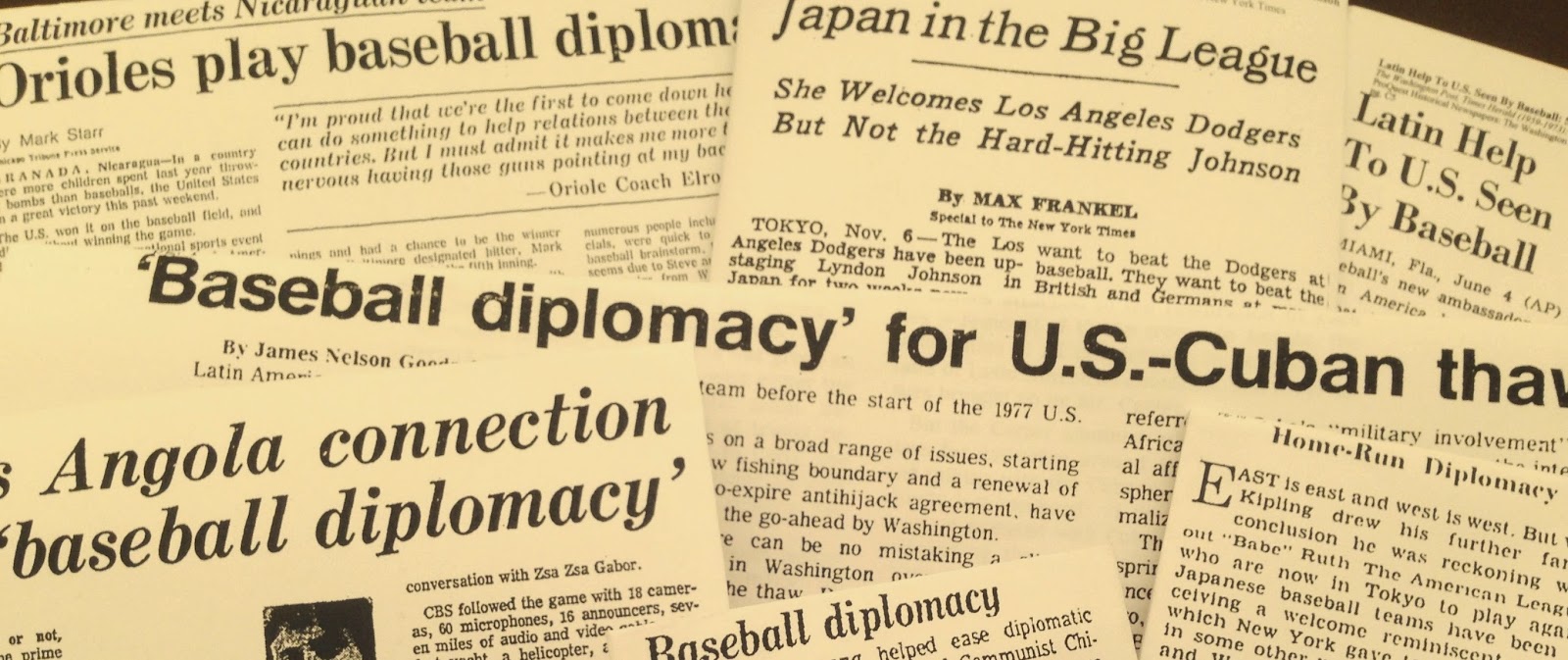
It has been called by many names - Baseball Diplomacy, Diamond Diplomacy, Home Run Diplomacy - but the concept is always the same.  By exchanging ball-players instead of politicians, and competing on athletic fields instead of battlefields, two countries can bypass complex government relations and generate a sense of good will among the people.  And it's not just baseball.  Basketball, soccer, ping pong and pretty much any sport you can think of has served this purpose at one point or another over the past several decades.